What are the best things to see in Chiang Mai?
The essential first-timer list mixes old-city temples you can walk between with one mountain temple and a day out in the hills. Most temples ask only a small donation or a modest fee, and they share a dress code: cover shoulders and knees, as these are active places of worship. Here is the Top 5.
Wat Phra Singh is the old city's most revered temple and the natural place to start. The classic Lanna architecture and the Phra Singh Buddha image make it the visual signature of Chiang Mai. Practical note: temple grounds are free to wander; the historic assembly hall asks foreigners for about THB 40. Open daily from early morning, western edge of the Old City.
Wat Chedi Luang centres on a vast, partly ruined brick chedi, once the tallest structure in the old kingdom before an earthquake took its top. It is the most atmospheric ruin in town. Practical note: entrance for foreigners is THB 40, open daily roughly 6am to 6pm, on Prapokklao Road in the heart of the Old City.
Wat Phra That Doi Suthep is the golden mountain temple, the postcard view of Chiang Mai and its most sacred site, about 15 km up the mountain with sweeping valley views. Climb the 300-step naga staircase or take the funicular. Practical note: temple entrance for foreigners is around THB 30 to 50 (the funicular is a small extra). The separate Doi Suthep-Pui National Park fee covers only the mountain's waterfalls and trails, not a temple visit by the main road, which travellers often confuse. Open daily from early morning; reach it by red songthaew from near Chiang Mai Zoo or by Grab.
Tha Phae Gate is the restored eastern gate of the old walls and the city's most photographed landmark, fronted by a plaza full of pigeons and the spot where the Sunday walking street begins. Practical note: free, open-air, always accessible, eastern edge of the Old City, a natural meeting point.
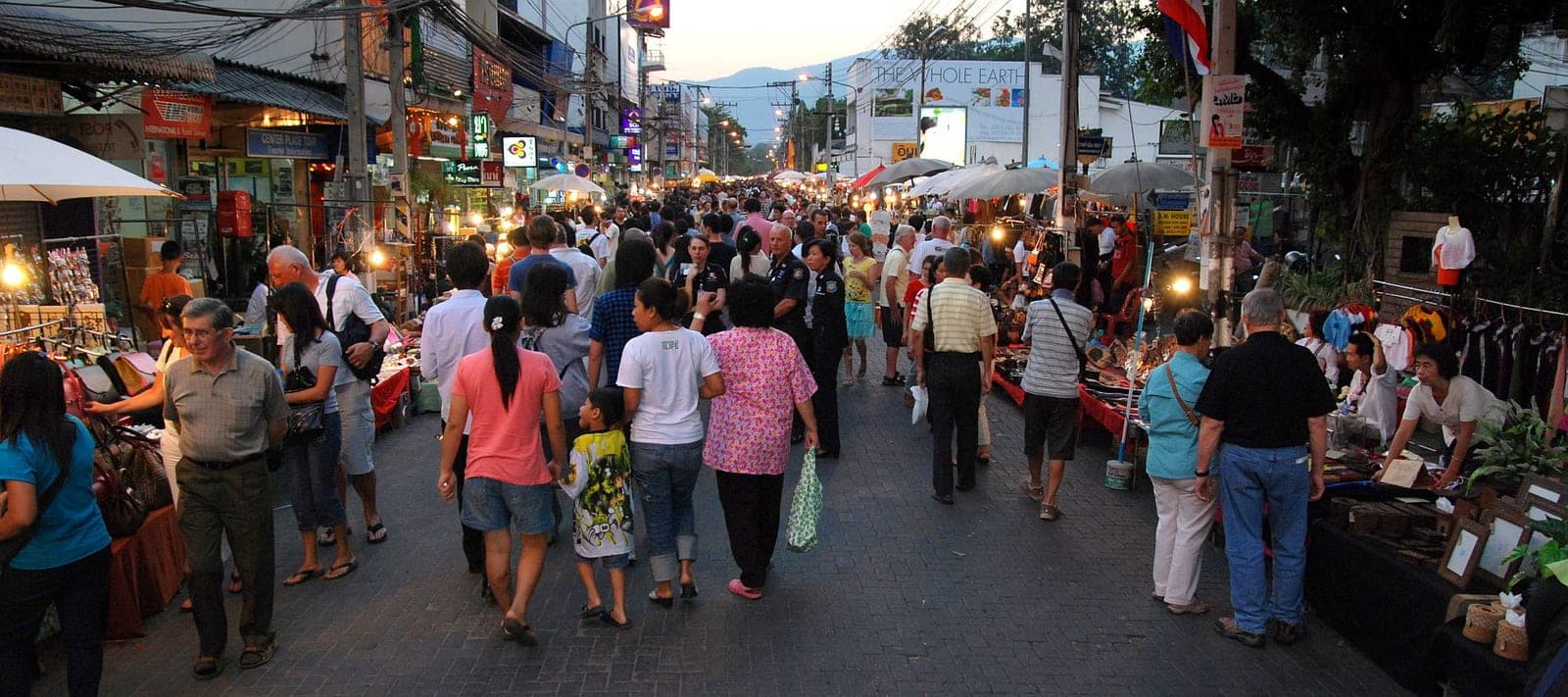
The Sunday Walking Street runs along Ratchadamnoen Road from Tha Phae Gate every Sunday from late afternoon (about 4pm) until late, the biggest and best of the city's markets for Lanna crafts, street food, and live music. Its smaller, more relaxed sibling, the Saturday Walking Street on Wualai Road (silver-makers' quarter), runs Saturdays from about 5pm to 11pm. Practical note: both are free; come hungry and arrive early to beat the crush.
Also worth your time:
- Warorot Market (Kad Luang), the city's biggest local market near the river, is the place to taste sai ua sausage and stock up on northern snacks. Indoor market open daily roughly 5am to 6pm, with a night section after.
- Bua Tong "Sticky" Waterfalls, about 60 km north, is a limestone falls you can climb barefoot without slipping. Free, open daily about 8am to 5pm, best as a half-day trip with a driver.
- Doi Inthanon National Park, around Thailand's highest peak, makes a full-day nature trip with waterfalls, the twin royal stupas, and cloud-forest trails. Foreign-adult park entrance is THB 300 (children THB 150), plus a small vehicle fee.
- An elephant visit, if the venue qualifies. The note below sets out the four limits Pai Dai applies and what the quotation confirms.
A note on elephants, because it matters. A venue that calls itself a sanctuary guarantees nothing by the name alone; what counts is what visitors are allowed to do there. Pai Dai offers an elephant visit only at a venue that meets four limits: no riding; no bathing or washing by visitors; no hand-feeding or unbarriered contact; no performances. Walk away from any camp that offers any of them. The venue on our published northern route is still being assessed against these limits, so if you want an elephant visit, the quotation says whether it is confirmed, and at which venue, or replaced with another day out.
Where should you eat in Chiang Mai?
The dish to chase in Chiang Mai is khao soi, the northern coconut-curry noodle soup at its very best up here: egg noodles in a rich curry broth, crowned with crisp fried noodles and served with pickled greens, shallots, and lime. Eat that first, then widen out to the other northern specialities and the markets. Also seek out sai ua, the herby grilled sausage fragrant with lemongrass and kaffir lime; nam prik num, a smoky roasted green-chilli dip; and gaeng hung lay, a mild, gingery Burmese-influenced pork curry.
For khao soi, Khao Soi Khun Yai ("Grandma's khao soi") near the moat in the northern old city is the local favourite, a bowl around THB 30-35, open roughly 10am to 2pm and closed Sundays, so go early before it sells out. The legendary, long-running khao soi houses along the river east of the old city are also worth the short ride. For everything else northern, Warorot Market is your dish-by-dish education: graze the food stalls, buy sai ua to take away, and try the pork rinds with chilli dip.
Beyond the specialists, the two walking streets become an open-air food court once a week, and Nimman delivers the modern cafe and dessert scene. Expect to eat very well for very little: a market meal runs well under THB 100, and a sit-down northern lunch rarely climbs far above it.
What does a perfect 3-day Chiang Mai itinerary look like?
A perfect first-timer plan gives Chiang Mai three days: day one for the old-city temples and street food on foot, day two for the mountain temple of Doi Suthep and a slow market afternoon, and day three for a nature trip or, if the quotation confirms one, an elephant visit. Three days covers the essentials without rushing.
Day 1, the old city on foot. Start early at Wat Phra Singh while it is cool, walk to Wat Chedi Luang, and weave between the smaller lanes and temples in between. Lunch on khao soi, rest through the hot middle of the day, then head to Tha Phae Gate for golden hour. If it is a Saturday or Sunday, the walking street is your dinner and your evening.
Day 2, the mountain and the market. Ride up to Wat Phra That Doi Suthep in the morning for the views and the most sacred temple in the north, then come back down for a slow afternoon at Warorot Market tasting northern snacks. Keep the evening loose for the Night Bazaar or a riverside dinner.
Day 3, nature or elephants. Choose your big day trip: the climbable Bua Tong Sticky Waterfalls, a full day in Doi Inthanon National Park, or an elephant visit if the quotation confirms one at a venue that meets the four limits. If it does not, either of the other two makes a memorable close to the trip.
This unhurried three-day rhythm is the backbone of our Northern Thailand Discovery journey, which threads Chiang Mai's temples and markets together with the wider Lanna north, and pairs naturally with a Thailand cultural circuit if you have more time.