Luxury Vietnam and Cambodia Mekong Journeys


Wanwisa Puengsawang
CEO, Pai Dai DMC
Vietnam and Cambodia share a long land border and the same river. The Mekong runs out of Cambodia, fans into the delta that carries its name in southern Vietnam, and empties into the sea below Ho Chi Minh City, so one route can take in Saigon, the Delta, Phnom Penh and the stone temples of Angkor at Siem Reap. For a planner, the decisions are the order of the two countries, how to make the connection (by air and road, or on a river cruise), how many nights the trip needs, and when to go.
Pai Dai's licensed companies operate in Thailand and Vietnam. Cambodia, including Siem Reap, Angkor and Phnom Penh, is offered as an extension to a Vietnam programme, and who operates it and how the handover works are confirmed for the dates.
Planning a private, tailor-made version of this trip? See our luxury, tailor-made Thailand and Vietnam journeys.
Why Vietnam and Cambodia combine so well
The case for pairing them is contrast. Cambodia is the temple country, with the sandstone city of Angkor and the modern history of Phnom Penh; Vietnam is the long coastal nation of cities, lantern towns, imperial citadels, and limestone bays. Put them in one itinerary and the days rarely echo each other. The Mekong makes the pairing physical as well as convenient: the same river system links the two countries, river cruises run the corridor between Saigon and the Cambodian capital, and a traveller can follow the water upstream into the Khmer heartland. The published sample route, Cambodia and Vietnam, is built on this pairing.
That sample route opens in Cambodia, with three nights in Siem Reap and one in Phnom Penh, then flies to Ho Chi Minh City and works north up Vietnam to Ha Long Bay. The river reads most naturally the other way, upstream from Saigon and the Delta to Phnom Penh and Siem Reap. Either direction works. Arrival flights and the season decide.
The route, beat by beat
The beats below follow the river upstream, from Saigon to Angkor. The sample route covers most of it the other way, by road and air, but without the Delta.
Ho Chi Minh City (Saigon). Vietnam's busiest city, and the natural place to start or finish the Vietnamese leg. Two nights covers the centre most people still call District 1, the war history at the Cu Chi Tunnels and the War Remnants Museum, and the markets, before the river pulls the route upstream.
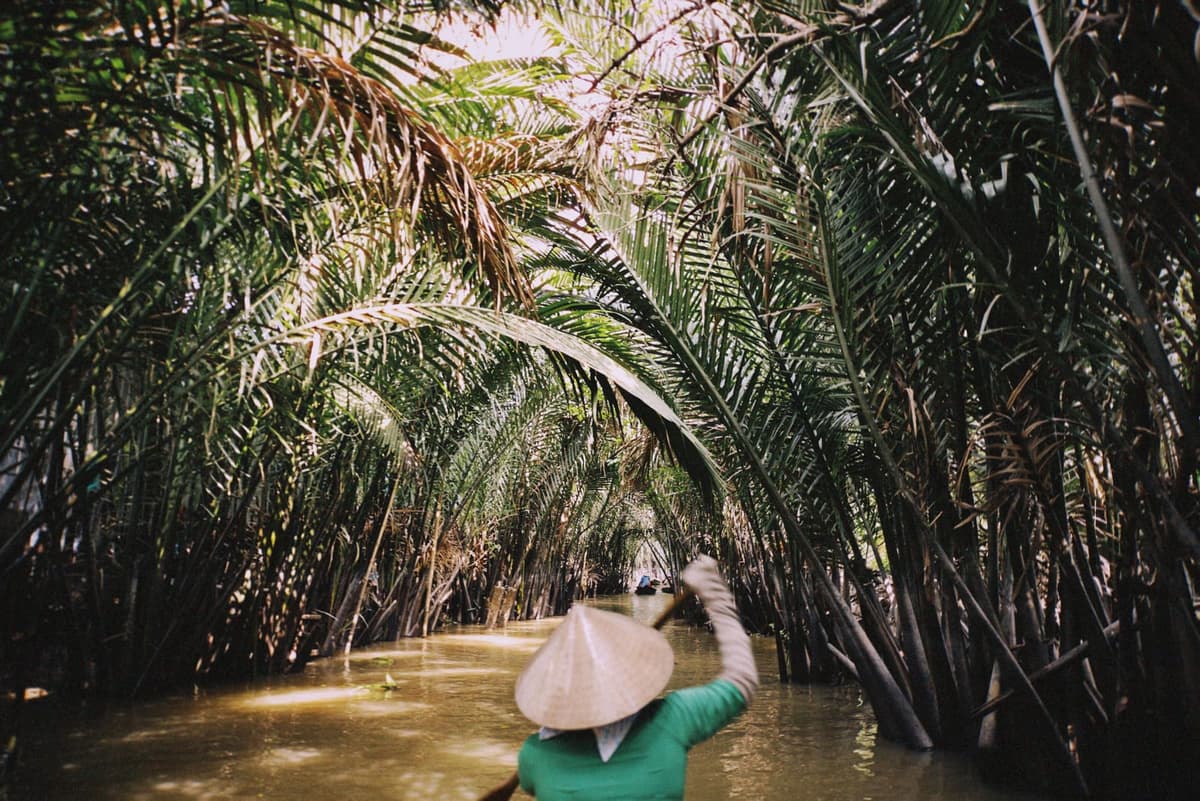
The Mekong Delta. South and west of Saigon, the river breaks into a maze of channels, floating markets, fruit orchards, and stilt villages. This is where a trip slows and takes to the water, whether for a day trip out of Saigon or for the first leg of a river cruise that carries on across the border.
Phnom Penh. The Cambodian capital, set where the Mekong meets the Tonle Sap. A night or two here covers the Royal Palace and the Silver Pagoda, and the essential, difficult history of the Khmer Rouge years at Tuol Sleng and the Choeung Ek memorial, with a guide who can handle it with care. Flights in and out now use Techo International Airport, which took over from the old Phnom Penh airport on 9 September 2025.
Siem Reap and Angkor. From Phnom Penh the river route moves on to Siem Reap, the base for the temples, which earns three nights. The sample route starts here instead. Clients land at Siem Reap Angkor International (SAI), about an hour's drive from town, so allow for the transfer on the arrival day.
At Angkor the days build. They start with sunrise over Angkor Wat itself, the largest religious monument ever built, its towers reflected in the lotus pond. Next comes the walled royal city of Angkor Thom, with the Bayon at its centre, where more than two hundred carved stone faces look out from the towers. Ta Prohm follows, the temple the restorers left in the grip of the forest, where the roots of silk-cotton and strangler fig have grown through the stonework. Further out is the small tenth-century citadel of Banteay Srei, cut from a pink sandstone that holds the finest carving at Angkor.

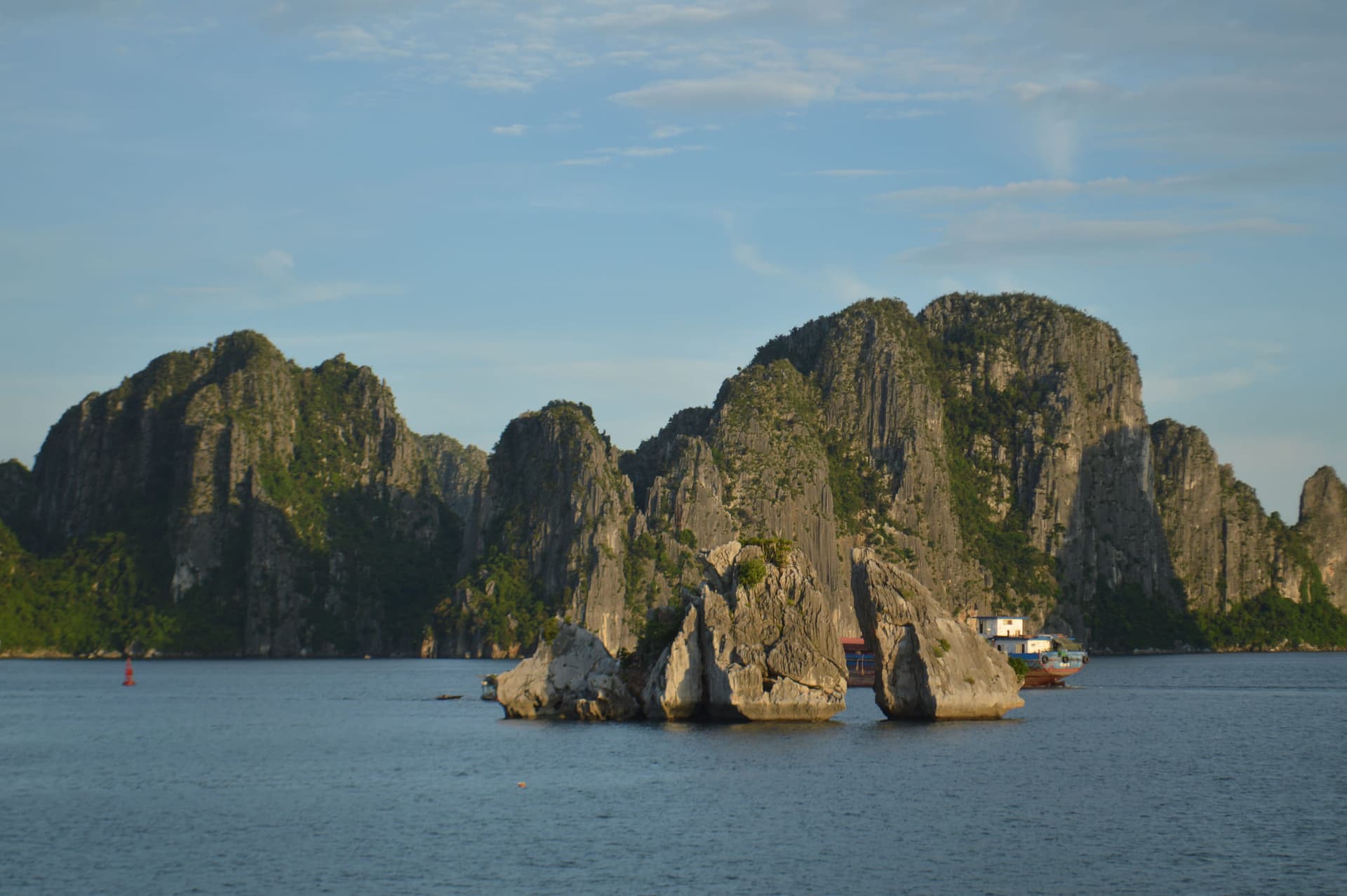
In the sample route, the Cambodian leg and Ho Chi Minh City take the first six nights. From Saigon the route continues up Vietnam's coastal spine: the lantern-lit old town of Hoi An on the Thu Bon, the imperial citadel of Hue over the Hai Van Pass, the capital city of Hanoi, and the limestone islands of Ha Long Bay as a finale. The route keeps going north well past the Mekong, which is why the combined programme needs real length.
The river-cruise option
The most distinctive way to make the Vietnam to Cambodia connection is to follow the Mekong on the water instead of by air. Luxury river cruise lines run the corridor between the Delta near Saigon and Phnom Penh on small, shallow-draft boats built for the river, with a slow programme of village stops, floating markets, and riverbank temples. To name one well-known boat by way of illustration, Aqua Mekong is selling sailings of three, four or seven nights through 2028, on itineraries that start and end in Ho Chi Minh City, Phnom Penh and Siem Reap. The appeal is the pace: the river is the trip.
The trade-off is time and rhythm. A river cruise adds slow days that a flight would compress into an hour, and it runs to a set schedule and direction, so it has to be planned as the spine of the trip. The efficient alternative is the one the Cambodia and Vietnam sample route takes, by road and air. Its Day 4 is the drive from Siem Reap to Phnom Penh, about 315 km and five to six hours with stops. Day 5 is the short flight from Phnom Penh to Ho Chi Minh City, and Day 6 is Cu Chi and the War Remnants Museum. There is no Delta day. To give clients the Delta, add a day out of Saigon or choose the cruise. Our Mekong Delta day-trip guide explains why My Tho and Ben Tre are long days and why the Cai Rang floating market needs an overnight.
When to go, and why the water level matters
The Mekong corridor and Cambodia share a simple two-season climate, so timing is more straightforward here than for Vietnam as a whole. The dry season runs roughly November to April, and this is the window for both the Delta and the temples: Cambodia is dry then, Angkor is most comfortable from November to February before the heat builds through March and April, and southern Vietnam is warm and travelable for much of the year besides. Our companion guide to the best time to visit Vietnam breaks the country down region by region, since the centre and north run on a different calendar.
The detail a river trip turns on, and that a land trip can ignore, is the water level, because the Mekong rises and falls across the year. Low water is the constraint. When the river is low, a boat cannot reach as far upstream, and the lines change the routing, for example with a flight or a road leg to Siem Reap. Aqua Mekong, for one, defines its low-water season as roughly December to mid-August and adds a flight to Siem Reap in those months. Each line sets its ports by the water level, so confirm the ports for the actual sailing dates before you build the land days around them.
| Window | The corridor and Cambodia | The river boats |
|---|---|---|
| Nov to Feb | Dry and coolest; Angkor at its most comfortable | Low-water routings from about December |
| Mar to Apr | Dry, with the heat building before the rains | Low water; boats reach less far upstream |
| May to Aug | Wet season, afternoon showers; temples stay open | Greener and quieter; low water can last to about mid-August |
| Sep to Nov | High water late in the wet season | Outside the low-water season; confirm the ports for the sailing dates |
How many days it really needs
A combined Vietnam and Cambodia itinerary is not a short trip, and compressing it is the planning mistake to avoid. To do both countries justice, plan on about 12 to 16 nights or more. The published sample route sits toward the lower end at 13 nights, 14 days: four nights in Cambodia, then nine in Vietnam from Ho Chi Minh City north to Hanoi and Ha Long Bay, with domestic flights compressing the long legs. The upper end leaves room for a Delta day, a slower pace along the coast, or the river-cruise leg.
Add river time on top of the land itinerary, not inside it. We cover the length question across the wider region in our guide to how many days you need.
What the luxury version looks like
The luxury here is less about any single hotel and more about how the difficult parts are handled: the temples walked with a private licensed guide, and the timing of each visit. Angkor Wat at sunrise is the classic start, and sunrise is also the busiest moment of the day there. So plan the route through the Bayon and Ta Prohm around the light and the crowds, with a guide who can read the bas-reliefs instead of reciting dates.
In Siem Reap the standard for a temple base is set by landmark houses such as the Raffles Grand Hotel d'Angkor or Amansara. In Phnom Penh, the colonial-era Raffles Hotel Le Royal is a classic address; and on the river, the luxury Mekong cruise lines provide the slow water leg. The names above are anchors for the level, not a booking: the right property depends on the group, the dates and what is available.
Whether you book the two countries as one programme or as two, the seam between them is where a shifted schedule causes trouble, so the proposal should show who is responsible for each leg and for the connection: who delivers the Cambodian services, which company you contract with for each leg, and who manages the handover. In the published sample route a Cambodian guide covers Siem Reap, Angkor and Phnom Penh, and a licensed Vietnamese guide takes over in Vietnam, with the handover at the Phnom Penh to Ho Chi Minh City flight. If you have a group or a private departure in mind, send us a brief and we will return a Vietnam and Cambodia outline, with or without the river leg, tested against the season. Our page on how we work with travel agencies explains net rates on registration.
FAQ
Can you combine Vietnam and Cambodia in one trip?
Yes, and it is one of the most natural two-country trips in the region. The countries share a border and the Mekong links them, so one route can run from Saigon and the Delta to Phnom Penh and the temples of Angkor at Siem Reap, or the other way round. Pai Dai's licensed companies operate in Thailand and Vietnam, and Cambodia is offered as an extension to a Vietnam programme; the quotation should name who delivers the Cambodian services, which company you contract with for each leg, and who manages the connection.
How many days do you need for Vietnam and Cambodia?
Plan on about 12 to 16 nights or more. The published sample route sits toward the lower end at 13 nights, 14 days, from Siem Reap to Hanoi and Ha Long Bay. The upper end leaves room for a Delta day, a slower pace along the coast, or a river-cruise leg.
When is the best time for a Mekong river cruise?
It is a trade-off. The dry season, roughly November to April, is the comfortable window ashore for the Delta and Angkor, with November to February the coolest, but much of it is low water, when boats cannot reach as far upstream and the lines change the routing, for example with a flight or road leg to Siem Reap. Aqua Mekong, for one, defines low water as roughly December to mid-August, so confirm the ports for the sailing dates.
How do you get from Vietnam to Cambodia?
The efficient way is the short flight between Phnom Penh and Ho Chi Minh City, which the published sample route uses; that route has no Delta day, so add one out of Saigon or choose the cruise if clients want the Delta. The slow way is a luxury Mekong river cruise between the Delta near Saigon and Phnom Penh.
Should Cambodia come before or after Vietnam?
Either order works, and the right one follows arrival flights, the season, and where the group wants the trip to peak. The published sample route opens in Cambodia, with three nights in Siem Reap and one in Phnom Penh, then flies to Ho Chi Minh City and works north to Ha Long Bay. Read along the Mekong itself, the route runs upstream from Saigon and the Delta to Phnom Penh and Siem Reap.
About the author
Wanwisa Puengsawang
CEO, Pai Dai DMC
Wanwisa Puengsawang, known as Sally, is the CEO of Pai Dai DMC. She leads the company's ground operations across Thailand and Vietnam, working directly with wholesale operators, MICE planners, and private clients.
More about Pai Dai DMCFor travel agencies
Planning Thailand or Vietnam for a client?
After we receive a complete brief, we provide a costed quote by the same time on the next business day. Complex multi-country or peak-season requests may take longer; we state the revised deadline when we acknowledge the request.